

Rating
⭐⭐⭐⭐
Spice
🌶️ (Barely)
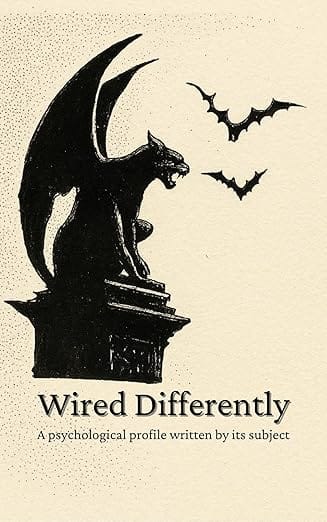
This book isn’t a confession or a cry for help. It’s an inside look at how someone with Antisocial Personality Disorder sees and understands the world. Not the version you find in textbooks or movies, but the real one. Thoughts, impulses, love, control, morality, all stripped down to what they actually feel like from the inside.
You’ll see how I was wired, how I learned, how I loved, and what I believe. But along the way, you’ll start noticing your own patterns reflected back at you.
By the time you reach the end, you won’t just understand me, you’ll understand the version of you that built me while reading.
This book is a little different than what I normally read. It’s not a fiction novel, nor is it even a proper story. “It’s more like a diary, fragments of thought, memory, and observation,” as the author so perfectly explains.
Part of what drew me in and led me to start reading this autobiography is the way the author bears their soul for us to see. Giving us a first hand insight into their life to maybe help us understand a group of people that are generally only portrayed in an educational or negative setting, if they’re acknowledged at all. I tend to enjoy psychological novels and learning about psychology in general. Since I haven’t seen many (if any) published first hand accounts of someone who’s aware they function a bit differently, this book intrigued me greatly.
My chapter summaries normally contain spoilers. For this review, they do not. I felt that doing so would minimize the experience I might convey to everyone. (Some things might be taken as spoilers. I tried to make them more like bullets or book blurbs. You know the gist of what you’re gonna read, but the rest of the text is still a surprise.) It’s important to note that I wrote each one as I finished the chapter, not all at the end.
Author, if you somehow stumble upon this, I hope my take is interesting.
Mini Chapter Summaries
Wired Differently
The author introduces themselves as someone who’s never truly been seen. Each person in their life sees a different them. The them that person wants. No matter how ‘close’ someone is to the author, they’ll only ever see a carefully curated mask. But not us.
We’re urged to mentally create a face for the author. To build and modify it as we read and learn more about them. I’ll add my mental description like this.
Blueprints.
Our first chapter is about the author’s childhood. How they viewed the world. How they learned the environment. How they came to understand others.
We’re shown how the author applies logic and sorts the world around them when they’re not yet aware that’s what they’re doing. How they learn not everyone sees life the same way they do. How contradictory and hypocritical some people are.
They describe how they naturally compliment (compliment may not be the best word) whoever they’re interacting with. Subtly becoming whatever will help them observe and influence the person best. Masking. Some of the behavior described would be a trauma response for most people. For the author, it’s just how they function.
The author starts out as a little boy to me. A child who’s just old enough to be trusted out in the backyard by himself. Bright eyed and fluffy, brown hair that needs to be trimmed. Can’t really be described as a happy, bubbly kid, but he’s nearly always content. I imagine he’s never without some kind of dirt from his explorations. Constantly fidgeting with whatever is in his vicinity as he learns and experiments.
As it’s implied the author ages, they turn almost genderfluid in my mind. On their own, they just are. The shift in perspective happens when they interact with others. Mostly a boy, but sometimes a girl. Instead of a mask, it’s an entire costume. I’m unsure why I mentally shift them. Not a single interaction described points to any gender.
Inside the Wires.
The author starts by explaining different sections of the brain. How they’re supposed to function, and then how they function for the author. Not how they don’t function, because they do, just not at the typical level. The author gives us general examples of how the functions would normally help or hinder someone. They explain how their interactions are objectively better without them.
When morality is brought up, we’re asked “instinct vs intention?” I read it as a hypothetical question, because that’s what’s easiest for me. I took a moment to think about which I’d prefer, then proceeded to go back and forth so much, I stopped for fear of blue screening myself.
Next, we dive into emotion. Anger, sadness, happiness, guilt, empathy, etc. The author experiences some emotions at a normal level. Some are muted, but present. Some are there, but different. Some don’t really show up at all. To me, the differentiating factor seems to be reliance on supposed morals or other feelings (sadness, guilt, empathy) vs pure emotion or situational reactions (anger, happiness, excitement). However, this isn’t a rule. It’s just the box I put things in to perhaps better understand the author. They might think my box is completely incorrect. Even I couldn’t perfectly fit everything they described into it.
In this chapter, I started to view the author as a young man. Still genderless during their explanations, but a man during their anecdotes. Someone in their late teens or early twenties. Not necessarily turning heads, but easy on the eyes. A mess of still fluffy hair with (when they can finally grow it) some short, well-kept facial hair.
Law of attraction.
The author now switches gears and talks about love. How he views romantic love not as a feeling, but as a challenge. A goal. A prize. Something that loses its sparkle once obtained.
The way the author treats romantic relationships, quite frankly, pisses me off. He behaves in a way that is sure to leave the other person feeling like shit. That said, this is my opinion. My morals. This far into the book, we’ve already learned that the author doesn’t subscribe to typical morals. He’s simply explaining, not asking for our opinions or for us to agree with him.
Once I got over my initial reaction, I quite enjoyed the anecdotes shared with us. I was honestly surprised by some of them. The way the author reacted to certain scenarios was wildly different than I originally expected. I thought I had a handle on how the author thinks, but all I had was a small piece.
I’m now only imagining the author as a man. The way he describes himself at this point (as wanting to be a father) makes it hard to see him as anything but. Same visuals as before.
Layers of belief
For our final chapter, the author talks about good and bad. Religion and ego. What, and who, defines good and bad? Will you still label an act bad when it’s you who’s forced to commit it?
Surprisingly, I agreed with nearly all that was said here. I may not follow everything in practice, but I definitely share similar sentiments.
Once more, my visualisation hasn’t changed much. Though, perhaps, the author now seems more like someone I would be around. I’d like to see him theorize or have a philosophical debate with someone.
Side note: Seeing “good” and “bad” so many times in the beginning got The One From Dark by Midnight Tyrannosaurus stuck in my head.
I was. (Epilogue)
We’re left with a goodbye. A reflection. A name.
I really enjoyed reading this book. A major part of me is my joy for learning. Figuring things out. This perspective provided that. Not a complete guide, but a better understanding.
Favorite Quote
And I’ve never been the type to hand over anything to an idiot. Especially my ten bucks.